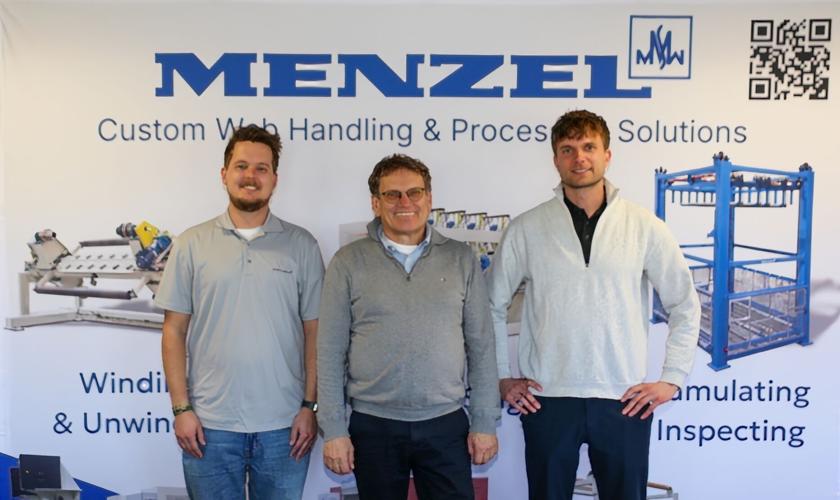
SPARTANBURG, S.C. — Outside Menzel’s Spartanburg facility, a section of the Berlin Wall stands as a quiet reminder of the company’s European roots — and the global history that has shaped its journey.
Inside, The focus Is Firmly On The Future.
Founded in Germany more than 125 years ago and established in the United States in 1965, Menzel has built its reputation on durable, custom-engineered machinery while evolving alongside a rapidly changing industry.
“We’ve always adapted to the market and found ways to keep the business moving forward,” said Hans Joachim Menzel, son of founder Hans Menzel, whose relationship with textile leader Roger Milliken led to the company’s expansion into Spartanburg.
That connection helped anchor Menzel in the heart of the Southeast’s textile belt — and laid the foundation for a business that continues to evolve today.
From Textile Stronghold To Specialized Markets
Menzel’s early success in the U.S. was built on traditional textile manufacturing, supplying equipment to mills across the Carolinas and beyond.
But as the domestic textile landscape shifted, the company adapted — expanding into technical textiles, coated materials, composites and other specialty applications.
“Ninety percent of what we do still relates to textiles — it just looks very different than it used to,” Menzel said.
Added General Manager Lasse Nienhaus, who relocated from Germany and assumed his role in 2025: “Everything that you can wind or unwind is a fabric that is suitable for our machines. Back in the day, most of it was textiles,” he added. “Now, it’s a lot of special fabrics — roofing membranes, coated materials, composites.”
That broader definition of textiles has allowed Menzel to remain relevant in an industry that looks very different from when it first arrived in Spartanburg.
Customization Defines The Business
Today, Menzel’s core strength lies in custom-engineered systems tailored to individual customer needs.
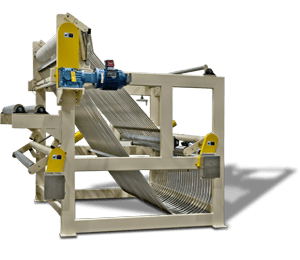
While the company is still well known for products such as A-frames and polyband expanders, its business has shifted toward larger, more complex projects — often involving complete lines designed for specific applications.
“Jobs have become much bigger, and much more custom,” Nienhaus said.
For Sales Engineer Kalen Caple, that complexity is exactly what sets Menzel apart.
“I don’t like to fit inside of a box,” Caple said. “I like to find a solution and think about it in a different way — not just to solve a problem, but to make it easier for the operator.”
Menzel agrees that customization is central to the company’s positioning.
“Custom machinery is where we can compete — that’s what we’re set up to do,” he said.
As manufacturers increasingly demand flexibility, efficiency and tailored solutions, that capability has become a key differentiator.
Engineering Longevity — And Loyalty
Menzel’s machines are known for their durability, with some systems remaining in operation for decades — a testament to the company’s engineering approach.
That long-term reliability has helped foster equally long-term relationships with both customers and employees.
“We’ve built machines that are still running decades later,” Menzel said.
Steve Chomutov, who has been with Menzel for 47 years, describes the company’s culture simply.
“It’s like my home,” he said. “Good people.”
Over nearly five decades, Chomutov has worked in multiple roles and now runs the saw department, bringing deep institutional knowledge to the operation.
“We have people here who have spent their entire careers with Menzel,” Nienhaus said. “That kind of loyalty is something you don’t see everywhere anymore.”
A New Generation Steps In
While that experience provides a strong foundation, Menzel is also actively investing in its future.
Nienhaus, 32, represents a new generation of leadership focused on modernizing how the company operates and connects with customers — from digital marketing and CRM systems to LinkedIn outreach and video-based education.
“We’re working on how we present ourselves and how we reach people,” he said.
Caple has been instrumental in those efforts, launching initiatives such as “Menzel Monday” social media posts on LinkedIn and helping expand the company’s presence across industry channels.
At the ownership level, succession planning is also underway.
Menzel’s son, Alexander — a Clemson University graduate currently pursuing his MBA — is in line to join the business, signaling continued family involvement.
“That gives us the opportunity to build something for the next generation,” Nienhaus said.
Global Roots, Shared Expertise
Although Menzel operates independently in the United States, it remains closely connected to its German counterpart, which is run by family members.
“We’re one company with different shareholders,” Menzel said. “We support each other — we share parts, collaborate on projects and work together when it makes sense.”
The two operations primarily serve their respective markets, but maintain a collaborative relationship that reflects the company’s shared heritage.
“We’re set up for North America, and the German company serves its markets, but we still work together when opportunities come up,” he added.
Diversification Supports Resilience
Menzel’s ability to adapt has also been supported by diversification beyond traditional textile machinery.
The acquisition of Fishburne, a well-known manufacturer of tobacco processing equipment,
added a complementary business line that continues to provide value today.
“We bought the people and the knowledge,” Nienhaus said.
That move helped stabilize the company during industry downturns and reflects its broader strategy of evolving with market demands.
Navigating A Changing Market
Like many manufacturers, Menzel is operating in an environment shaped by global uncertainty, shifting supply chains and evolving customer expectations.
Investment cycles have lengthened, and customers are often more cautious when committing to large capital projects.
“In this business, you’re always going through cycles — you win a big job, or you fight for the next one,” Menzel said.
“There’s a lot of hesitation right now,” Nienhaus added. “People are unsure about the economy, so they don’t want to spend money too quickly.”
Still, the company is seeing positive momentum, with strong project activity early in the year.
“The industry has changed a lot over the years, but we’ve found ways to adjust and continue building the business,” Menzel said.
Building For What’s Next
For Menzel, the path forward is defined by a balance of tradition and transformation.
Its German engineering heritage, long-standing workforce and deep customer relationships provide stability — while its focus on customization, digital engagement and next-generation leadership positions it for continued growth.
“Flexibility and customization are what set us apart,” Caple said.
From a piece of the Berlin Wall on its front lawn to a new generation shaping its strategy, Menzel’s story reflects both where the industry has been — and where it is headed.
With decades of engineering expertise and a commitment to evolving alongside the industry, Menzel is prepared to support your next step. Contact us today and let’s build the systems that will carry your operation into the future.
For more than 65 years, Menzel LP has led the industry with innovative, high‑quality, customer‑focused engineering. From our groundbreaking A‑frame winding system of the 1960s to today’s advanced web‑handling solutions, we remain committed to technical excellence, collaborative problem‑solving, and delivering customized equipment that enhances manufacturing efficiency worldwide.